Why do the students use a systems engineering approach? #
The Capstone Project is the 6th and final compulsory systems engineering course in the ANU engineering program. By this stage, students have already applied a systems engineering approach to real-world-style problems in earlier courses. The capstone project is the first time they do so for a real external stakeholder, and with a high degree of autonomy in how they define, scope, and approach the problem.
A systems engineering approach is used because it reflects how professional engineers work when faced with complex, ill-defined challenges. It emphasises understanding the whole problem, engaging with stakeholders, managing uncertainty, and integrating technical and non-technical considerations.
The course is intentionally student driven, with minimal teaching time. Teams are expected to manage their own project, engage stakeholders, and tailor their approach to the unique goals and challenges of each project.
If you are unfamiliar with a systems engineering approach the Systems Engineering Society of Australia provides a nice summary - What is Systems Engineering.
What is ‘Many Eyes’? #
The Capstone course employs a 360-degree feedback approach, referred to as the “many eyes” method (Figure 1), to monitor project progress. This approach integrates insights against multiple criteria from four key stakeholder perspectives: self-evaluation, peer (or “shadow”) feedback, tutor evaluation, and the project host’s perspective. By considering feedback across these multidimensional criteria, student teams gain a more comprehensive understanding of their project’s progress, as opposed to relying on a single feedback source that may reflect only the specific interests of one reviewer.
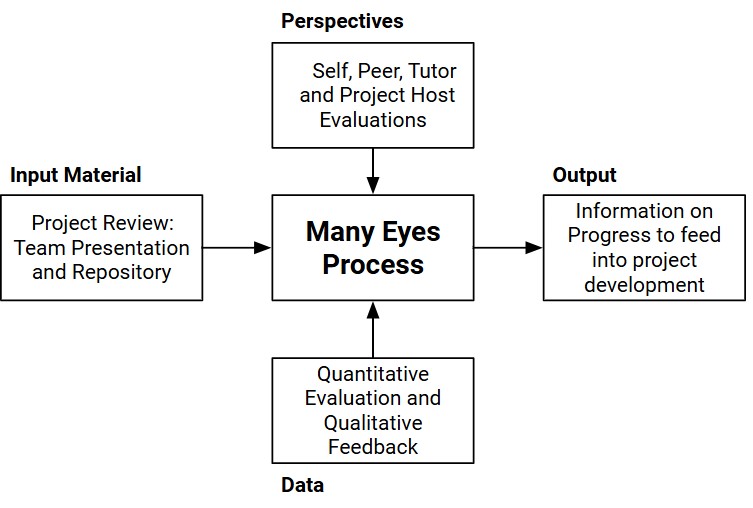
During audit weeks, project hosts will be send a form to provide feedback to the team as one of the “many eyes”. Completion of the form is voluntary.
What is ‘Project Selection Night’ and how does it work? #
The project selection night is an event to advertise your project to prospective students. It is run in a ‘two-way’ interview format, allowing you to know more about the students and identify those you would like to have in your team whilst enabling the students to learn more about each project and submit their project preferences.
The event occurs online from 5 to 7 pm on an evening in mid to late February or July (week 1 of semester), depending on the semester the project is offered. Full instructions for the night will be sent with an invitation via email prior to the event.
While there are no strict requirements for presenting your project, many project hosts find it helpful to prepare a brief pitch (1-2 minutes) and, where appropriate, include supporting materials such as photos of sites or equipment to enhance their presentation.
After the selection night, you have until noon the following day to submit your student preferences via email to the teaching team. While this is optional, we will make every effort to accommodate your choices. However, due to various factors involved in team formation, it is unlikely you will receive all your requested students. If you have specific arrangements, such as a pre-formed group, please inform us as soon as possible.
If you are unable to attend the project selection night, please let us know promptly. We recommend providing a recorded pitch or a written script, which we will share with the students via our learning management system.
What is the Project Showcase? #
The project showcase event takes place in week 12 of the team’s final semester. The event is a showcase of student and research projects from all parts of the College of Systems and Society. The student teams will present a poster, prototypes and displays (if appropriate) and prepare a 3-minute video pitch (available via QR code) that summarises their project and its value to stakeholders. We strongly encourage project hosts to attend the showcase and will provide further details closer to the event.
What is the Mid-project Presentation? #
The mid-project presentations take place shortly before the teams’ second audit, offering students a valuable opportunity to convey the purpose and significance of their projects to an unfamiliar audience. This exercise focuses on developing their ability to communicate complex and detailed work effectively to individuals who may not be familiar with the specifics of their project. During the presentation, teams share their progress with the teaching staff and fellow students within the Capstone course, fostering feedback and collaborative learning.
Project hosts do not attend the mid-project presentations, but your team are welcome to present to you separately.
What is the Project Agreement? #
As a formal recognition of the relationship between you, the student team, and the ANU, we will ask you to sign a project agreement. It sets out key aspects of the relationship, including the responsibilities/expectations of the different parties. Some examples to responsibilities/expectations include confidential information, intellectual property, work health safety, insurances etc. The agreements have been prepared by ANU legal.
For projects provided by hosts external to the ANU, two documents are required:
- STP 01 Industry Project Agreement - the agreement between the host and the ANU
- STP G02 Student Group Project Agreement - the agreement between the student(s) and the project host
DocuSign will be used to execute external agreements.
For projects provided by hosts internal to the ANU (for example undertaken internally with an ANU School or College), STP G05 Internal ANU Student Group Project Deed will be used. This is an agreement between each student and the ANU.
Preliminary agreements for each project, outlining agreement conditions but excluding student details, must be made available to students prior to project selection night to allow them to read and understand the conditions for each project and seek independent legal advice. If an agreement is not in place, we will be unable to offer the project. The course convener will contact you to discuss the agreements prior to the start of the project.
What funding and resources do the ANU provide? #
The ANU has a limited number of microgrants available for students to develop their projects/prototypes. These microgrants can go up to $150 (or more in limited cases); your student team can reach out to the course convener for approval.
Additionally, College of Systems and Society students have access to resources available via the Engineering Technology Hub, the Engineering Workshop and the ANU Makerspace, including 3D printing, machining tools, basic workshop facilities, soldering and small electronics equipment, IT hardware/services, and an extensive suite of software packages. We also have limited storage space and project workspace on campus.
Can students work on or visit the project host site during the project? #
Yes, however insurance must be arranged prior. The ANU has a general insurance policy to cover students working off-campus. Each student will still need to notify the University of the locations that they are doing work, the type of activities that will be completed and be approved by the convenor before working off-campus and may be required to complete risk assessments.
If you are planning any site visits or other activities for the students, please give them notice so that they can complete the required notification forms and submit them to the School of Engineering (it is a relatively quick process, so a couple of days is fine).
Students must complete a WHS risk evaluation for activities planned during the project. This includes activities conducted at the ANU or the project host site with separate risk assessments required for each case.
If your project requires students to complete activities at your worksite or another non-ANU location, you should work with the students to complete a work health and safety assessment or induction, supervision and training and access to personal protective equipment as required. Approval from the School may be required for higher-risk activities.
Students undertaking interstate travel may be required to complete ANU travel forms which may take more than a couple of days to process. The students should arrange this in consultation with the course convenor.
What recommendations do you have for creating a project scope? #
We recommend a project scope is intentionally flexible, allowing you and your student team to collaboratively define a preliminary scope that aligns with the team’s skills and capabilities. However, the project must adhere to systems engineering processes, tools, and methodologies, as these are the primary areas of student assessment.
The project scope may evolve over the year. If significant changes to objectives or deliverables occur, students should prepare a revised Concept of Operations (ConOps) document, ensuring it is reviewed and signed by all relevant stakeholders. If scope changes affect project risks, updates to the Work, Health and Safety (WHS) risk assessment and corresponding approvals will also be required. Our goal is to ensure that both you and your student team achieve meaningful outcomes and value from the project.
When will projects start and what if my project does not go ahead? #
The course accepts new student intakes at the start of each semester. Projects will begin in February and July each year.
Due to many students pursuing double degrees, enrolments can vary between semesters as they balance course requirements across engineering and other disciplines. As a result, some projects presented during the selection night may not progress within a given semester. However, with new students joining each semester, we encourage you to pitch your project again in the next round.
How long does a project run for? #
The Capstone Design Project is a two-semester course. Projects that begin in February will conclude in November of the same year. Projects that begin in July will conclude in May of the following year.
Students are expected to allocate approximately 10 hours per week to the project over 12 weeks per semester. This equates to roughly 240 hours per student for the year. Teams typically consist of 4-6 members.
We encourage teams to work with you to determine the most effective use of their time, considering their other commitments, including other coursework, employment, internships, and project timelines. Ideally, students will complete their project hours during the teaching semesters, as teaching support is unavailable during breaks or between semesters.
If the scope of your project would extend beyond a single team, you are welcome to offer a project that extends into additional iterations of the course. A new team of students will extend the work of the previous team. We have had very strong results from projects that have extended over several iterations of the course.
How do the projects manage Intellectual Property? #
By default, ANU students own their intellectual property (IP) as outlined in the ANU Procedure - Student intellectual property The default position in the agreement is consistent with the ANU Procedure.
As the project is completed for course credit, the students will own their Assessable Work (that is any materials or works that a student creates in connection with their Project which is required for examination of assessment). An option exists for students to assign the Project IP (that is any intellectual property that a student creates in connection with their project that is not required for examination or assessment) to the project host. A licence options is also available. These options can be discussed with the course convener.
How do the projects manage confidential information? #
If your project is likely to have sensitive or confidential information accessible to students, please note this in your project proposal. Within this course, sensitive or confidential information may be accessed by the student project team working on your project and the shadow student teams and/or tutors in assessing and reviewing your student project team’s work. All groups will be bound by confidentiality requirements where you have identified information as confidential.
If this is a concern, we recommend scoping the work so that students do not require access to confidential material. Where necessary, project hosts are encouraged to provide de-identified or synthesised data that preserves the structure of the real problem without exposing restricted information.
Capstone requires students to present their work to the public at the Project Showcase. This may present challenges for students subject to confidentiality agreements. However, it is usually possible to present work without violating such agreements. In all cases, whether subject to agreements or not, students should seek approval from you, their project host, and other relevant stakeholders before any public presentation of their work.
What are the required submissions/assessments for the course? #
The Capstone Design Project has intentionally few required submissions. Student teams are expected to set their own project goals in consultation with their project host, and to define their systems engineering approach and project governance with guidance from their host and tutor. The course does not prescribe the specific work students must complete; progress is driven by the team’s own planning and engagement with the project.
We do, however, require students to document their work so that their progress, approach, and outcomes are transparent. This documentation forms the basis of the project audits.
The following submissions are required by the course:
- Concept of Operations (ConOps) This is a key document in establishing the project. It is an agreement between the project host and the team that explicitly states the objective of the project from a user perspective.
- Project management plan The is a living document that is used to manage project planning.
- Project Repository The project repository is where the students complete and store all project work. It will contain all of the teams project documentation and governance (e.g., meeting minutes, risk assessments, communications, logs and so on). Teams are responsible for determining the contents of the project repository.
- Landing Page The landing page is a ‘front page’ for the project. Commonly a website, it is used to give a high-level overview of the project, the team and their progress.
- Showcase Poster and video pitch
- Final team review A three-page document submitted at the end of the project where the students recommend an evidence based final project grade for the team
Capstone includes four project audit weeks spaced throughout the year. Audits provide qualitative and quantitative feedback organised by the stakeholder group, allowing the team to judge how the project is progressing and how to improve. Acting on this feedback will help the student project team deliver value to their project host. Each audit has a specific purpose as detailed below.
| Project Audit | Purpose |
|---|---|
| Project audit 1 | Establishes the project including the scope and goals through the creation of the Concept of Operations (ConOps) document. Establishment of governance processes, including risk analysis and project management plans. |
| Project audit 2 | Reporting on progress of project goals and project governance. Draft system engineering design documents for example requirements analysis, systems architecture, and functional analysis as appropriate. |
| Project audit 3 | Reporting on progress of project goals and project governance. Plans to test and validate the solution. Plans for the completion and handover of the project to stakeholders. |
| Project audit 4 | Reporting on and evaluate the final outputs of the project goals. Finalise any project, governance and handover documentation. |
Other assessments include the group mid-project presentation and two individual reflections submitted during the exam period of each semester.
Who can I contact if I have questions about Capstone? #
To enquire about getting involved in Capstone please reach out to our Engagement & Impact team (Mike Hanauer and Cathy Zhou) -engagement.eng@anu.edu.au
Your student team is responsible for providing you with any information about the course that they have access to but if you need any more information, or have any questions you can reach out to:
- Our course email address - engn4300.css@anu.edu.au
- Dr Zena Assaad (Course Convenor) – zena.assaad@anu.edu.au
- Jenny Simmons (Course Administrator) – jenny.simmons@anu.edu.au
- The tutor for your team (you can get the name/email from your team or Jenny if you have not already been contacted).
Additional Information #
You can find more information in the student course documentation.
Version Control #
Document Information #
| This document | ENGN4300 Project Host FAQ |
| Format | Web page |
| Document type | Frequently asked questions |
| Purpose | Overview of course requirements, governance and processes for project hosts offering projects in ENGN4300 Systems Design Project |
| Semester | Semester 1, 2026 |
| Audience | Current or potential hosts |
| Contact | Dr Zena Assaad |
| Version | v2026 S1.1.0 |
| Related content | ENGN4300 Course Outline, Course Governance and Assessment Guide |
Change log #
2026.S1.01: 07_01_2026
- Initial version S1 2026